Most people in Bryant judge a roof by the part they can see from the driveway. The shingle color, the straight lines, whether the ridge looks crisp against the sky. The layers underneath do the actual work, and by the time a crew finishes, almost none of them are visible again.
That hidden stack is worth understanding before anyone signs off on a replacement, because a poor roof and a good one can wear the same shingles on top. The difference sits below.
Lifetime Construction Builders LLC · 3519 Market Place Avenue, Bryant, AR 72022 · (501) 307-1440
It starts with what comes off
A replacement begins with a tear-off down to the bare decking. No new shingles go over the old ones on a proper job. Once the deck is exposed, the crew can finally see what years of Arkansas weather did to the wood. Soft spots show up where water worked in around a pipe boot or a nail pop. Those panels get cut out and replaced.
Skip that step and the new roof rests on a spongy base. Fasteners hold poorly, the deck flexes, and the next leak finds the same weak point. Lifetime Construction Builders, the family-owned contractor based on Market Place Avenue, includes replacing soft decking in its replacement sequence, which matters in a town where spring hail and straight-line wind work on roofs every year.
The edges come before the field
Drip edge goes on along the eaves and rakes. It is a simple L-shaped piece of metal, and its job is to push runoff past the fascia board instead of letting it wick back into the wood. Gutters that overflow in a spring downpour are one thing. Water curling under the edge of the roof deck is another, and the drip edge is what stops it.
Then the ice and water shield goes down at the eaves and in the valleys. This is a self-adhering membrane, and it seals around nails driven through it. Bryant sees the odd winter ice storm, and that is reason enough to protect the eaves. The valleys are where two roof planes meet and where the most water concentrates during any storm.
The underlayment layer
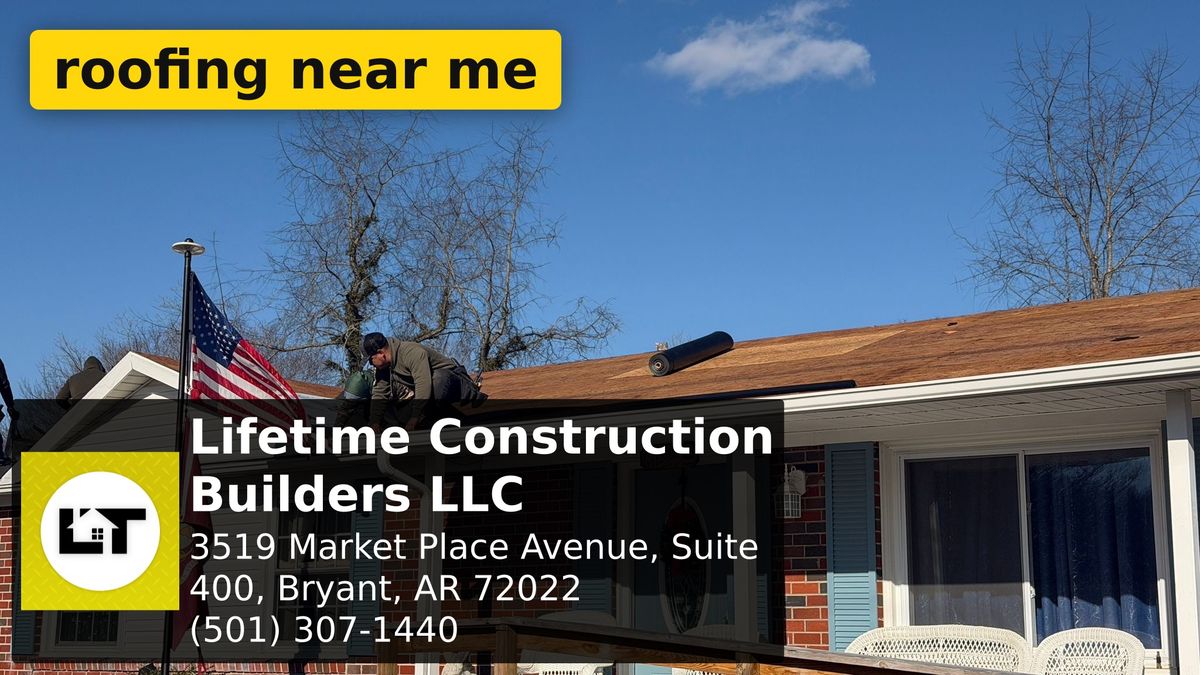
Over the shield, the crew rolls synthetic underlayment across the rest of the deck. It is a woven sheet that sheds water that gets past the shingles during a blow and gives the shingle course a consistent surface to lie on. Old felt paper worked for decades, and synthetic has largely replaced it because it holds up better to sun during the day or two the roof sits open.
That matters on any roof, in Hurricane Creek or out toward Bryant Parkway, because a roof is stripped before it is covered. The underlayment is what keeps the sheathing dry if weather turns before the shingles go on.
Shingles, panels, and the choice that follows you home
Asphalt shingles remain the common choice on Bryant homes, and in this sun they typically last somewhere around 15 to 25 years. The Atlas lines the company installs include Pinnacle Pristine, Pinnacle Impact and Pinnacle Sun, along with StormMaster Shake and Legend. Some carry impact ratings for hail. Others are built for wind. A cool-roof shingle helps with the long humid summers that bake a standard shingle from May through September.
Metal is the other road. Standing seam panels in 24-gauge Galvalume, an R-panel in 26-gauge, or stone coated steel from DECRA, TILCOR or Westlake Royal all take longer to install and change the look of the house. On an R-panel, exposed fasteners get re-screwed over the years as the washers age. Standing seam hides its fasteners.
Flashing and the ridge
New flashing goes in at every penetration and every wall the roof meets. Chimneys, skylights, sidewalls, step flashing where a lower roof tucks against an upper one. A roofer who smears sealant over old flashing instead of replacing it has bought the homeowner a season or two at best. Sealant cracks. Metal does not.
At the top, a ridge vent runs the length of the peak. Hot air that builds in the attic escapes through it, and the intake at the soffits pulls cooler air in below. Without that flow, the attic turns into an oven, the shingles cook from underneath, and the air conditioning works harder all summer.
Why the sequence matters
Each layer depends on the one below. Ice and water shield only seals if it bonds to clean decking. Underlayment only lies flat if the panels beneath it are sound. Shingles only lock down properly when the underlayment gives them an even bed. A crew that rushes one step creates a weak link that will not show until the next big storm.
This is where the front-end work earns its keep. A roof inspection Bryant homeowners can rely on takes about an hour on the roof, photos included, and answers whether a house needs a repair or a full replacement. Lifetime Construction Builders does that inspection for free and puts the findings in a written estimate that does not move afterward. For anyone comparing quotes, that written scope tells you whether decking, flashing and underlayment are included or quietly left out.
What the neighbors say
Reviews are what turn up first when someone searches best roofing Bryant Lifetime Construction Builders, and they circle the same points. Chris Oxender wrote that "the cleanup was perfect. It was done in one day." Clark Robinson has hired the company three times and called the team "always on time, communicative, and responsive to phone calls while solving problems." Sandra Sumner, on her first roof, said the whole process "was a great experience."
Cleanup is its own layer of trust. Nails in a driveway or a pool are a genuine hazard, and the company sweeps the yard with a magnet after the crew leaves. For a homeowner near Bishop Park, that last pass counts as much as the ridge vent.
Picking a roofer after a hailstorm
Bryant sits along Interstate 30, and after a hailstorm some door-knockers arrive. Some carry a license and a local address. Others collect a deposit and vanish. Ask for the license number: Lifetime Construction Builders lists RR0540591024, along with general liability and workers' compensation coverage. Those numbers are checkable, and they say whether a crew is insured before it climbs a ladder.
The same caution applies to insurance claims. When a carrier approves a patch on a roof that is worn across whole slopes, the homeowner can push back. The company helps with the claim paperwork at no extra charge, and storm calls get a same-day visit with a tarp if water is coming in.
For anyone searching roofing near me after a bad night, the shorthand version: get the inspection, read the written scope, and ask what happens under the shingles. A roof built in the right order holds. A roof built fast does not, and the difference never shows from the street.
Around town
The company covers Bryant, Benton, Alexander, Haskell and Shannon Hills, from the Bob Herzfeld Memorial Library on Smithers Drive in Benton to the streets off Shobe Road and the Alcoa Road corridor in Bryant.
For a homeowner weighing whether to patch or replace, an inspection is the honest starting point, and it is the first step in any roofing Bryant AR job done in the right order. The best roofing Bryant homeowners can get is built on that first hour on the roof, and on every layer that follows it.